
LCL Awards develops UK-first HIU training course with Bosch Commercial & Industrial
28 Jun 2026
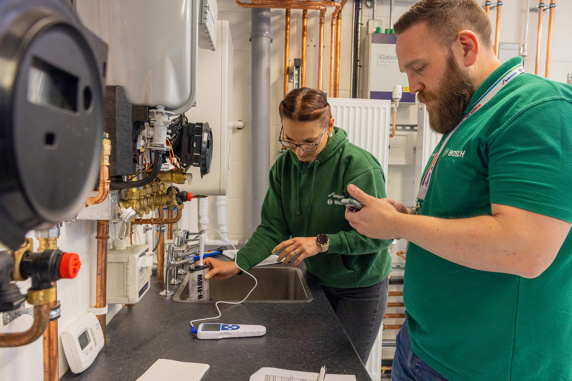
LCL Awards has developed a new certified training course with Bosch Commercial & Industrial, aimed at increasing the quality of Heat Interface Unit installations.
The two-day course held at the Worcester Training Academy looks to help prepare installers for the incoming Heat Network Technical Assurance Scheme (HNTAS) and has been developed with the recently published “MEHNA Heat Network Installer Training Guide” as its basis.
The course focuses on the practical elements of installation and commissioning of HIUs with defined test methods that will need to become second nature for installers working under HNTAS. It introduces installers to likely Acceptance Testing methods necessary during commissioning and shows how to save time by adopting sound installation practices from the outset.
Neil Ovenden, Operations Director at LCL Awards said, “Heat networks have a critical role to play in achieving Net Zero, but their success depends on having a skilled workforce capable of installing, commissioning and maintaining Heat Interface Units (HIUs). This pilot programme was a vital first step in creating the industry's first regulated HIU qualification, which we hope to launch by the end of July. We are delighted that LCL Awards, working alongside Worcester Bosch, has been able to lead this important development and help establish the standards needed to support the sector's future growth."
Darren Danks, Head of Training and Qualification at Worcester Bosch, said, “To ensure we were delivering the best possible experience for our customers, we ran a comprehensive pilot course to test the syllabus. The insights we gained were invaluable, and the hands-on format has already proven to bridge a vital knowledge gap.”
Phill Rowley, an attendee on the pilot course, added, “The practical side of the course was very good, offering a great chance to put into practice what is expected when commissioning a HIU. These types of courses are very important because they help improve industry skills, ensuring correct commissioning practices that directly protect and improve overall heat network efficiency."
For those working on the maintenance of HIUs, it includes practical fault-finding methods that cover both HIU and heat network related faults. Successful candidates will obtain an LCL certificate, helping to demonstrate the training requirements under HNTAS.
Pete Mills, Commercial Technical Operations Manager for Bosch Commercial & Industrial, commented, “We’ve purposefully designed our new course with the MEHNA guide in mind. By working through it, we will train installers to adopt best installation practices that align with the requirements of the TS1 standard developed for HNTAS.
“These skills are an essential part of getting heat networks right from the start and will support the boost in green jobs that the Government is planning for the heat network sector. We are committed to supporting the industry transition to a multi-tech heating future and pioneering this first-of-its-kind course is one of many steps we are taking to do so.”
The first two courses start on the 21st July and 24th August. To find out more please contact the Worcester Bosch Training team via training@uk-bosch.com.
LCL Awards centres interested in running this course should contact Neill Ovenden: neill.ovenden@lclawards.co.uk
Heat Interface Units: Exploring opportunities in a growing sector
Heat networks are expected to become a much bigger part of the UK’s heating system over the coming decades. As more communal and district heating schemes are installed, demand is growing for professionals who understand the technologies that make these systems work, including Heat Interface Units (HIUs).
The expanding heat network sector presents a valuable opportunity to develop skills in an area that is expected to see significant growth in the years ahead.
What is a Heat Interface Unit?
A Heat Interface Unit (HIU) is a device that transfers heat from a centralised heat network into an individual property. Rather than generating heat on-site, the HIU receives heat from a central energy source and transfers it to the property’s heating and hot water systems. This allows each dwelling to benefit from individually controlled heating while remaining connected to a larger network.
HIUs are commonly found in properties connected to heat networks, including communal heating systems, community heating schemes and district heating networks. These can be found in:
● Apartment blocks
● Large residential, multi-occupancy residential and retirement living developments
● Student accommodation
● Social housing schemes
● Hospitals
● Universities
● Mixed-use developments
In these applications, HIUs act as the interface between the heat network and the end user.
Why is the market growing?
The growth of the HIU market is closely linked to the UK’s wider decarbonisation strategy.
Heat networks are increasingly being recognised as an effective way to provide low-carbon heating in densely populated areas. They can utilise a range of energy sources, including large-scale heat pumps, waste heat recovery and other low-carbon technologies, helping to reduce reliance on individual fossil fuel heating systems.
Government policy is also helping to drive adoption. The Energy Act 2023 introduced a framework for greater regulation of heat networks, while ongoing work around heat network zoning is intended to encourage further investment and deployment in suitable areas.
At the same time, the continued development of high-density housing, build-to-rent schemes and large residential projects is creating a growing market for communal and district heating systems.
For the heating industry, this means one thing: more heat networks will require more HIUs.
What are the opportunities for heating installers?
The continued growth of heat networks across the UK will require a competent workforce to deliver. From installation and commissioning through to servicing and maintenance, HIUs will need engineers with the knowledge and skills to work safely and effectively with these systems.
For heating professionals looking to future-proof their skills, HIU expertise represents an opportunity to develop knowledge in an expanding area of the low-carbon heating market. With HIUs becoming increasingly common in multi-occupancy buildings, social housing and large-scale residential developments, an understanding of HIUs and heat networks could become a valuable addition to an engineer’s portfolio.
LCL Awards has developed a new certified training course with Bosch Commercial & Industrial, aimed at increasing the quality of Heat Interface Unit installations.
The two-day course held at the Worcester Training Academy looks to help prepare installers for the incoming Heat Network Technical Assurance Scheme (HNTAS) and has been developed with the recently published “MEHNA Heat Network Installer Training Guide” as its basis.
The course focuses on the practical elements of installation and commissioning of HIUs with defined test methods that will need to become second nature for installers working under HNTAS. It introduces installers to likely Acceptance Testing methods necessary during commissioning and shows how to save time by adopting sound installation practices from the outset.
Neil Ovenden, Operations Director at LCL Awards said, “Heat networks have a critical role to play in achieving Net Zero, but their success depends on having a skilled workforce capable of installing, commissioning and maintaining Heat Interface Units (HIUs). This pilot programme was a vital first step in creating the industry's first regulated HIU qualification, which we hope to launch by the end of July. We are delighted that LCL Awards, working alongside Worcester Bosch, has been able to lead this important development and help establish the standards needed to support the sector's future growth."
Darren Danks, Head of Training and Qualification at Worcester Bosch, said, “To ensure we were delivering the best possible experience for our customers, we ran a comprehensive pilot course to test the syllabus. The insights we gained were invaluable, and the hands-on format has already proven to bridge a vital knowledge gap.”
Phill Rowley, an attendee on the pilot course, added, “The practical side of the course was very good, offering a great chance to put into practice what is expected when commissioning a HIU. These types of courses are very important because they help improve industry skills, ensuring correct commissioning practices that directly protect and improve overall heat network efficiency."
For those working on the maintenance of HIUs, it includes practical fault-finding methods that cover both HIU and heat network related faults. Successful candidates will obtain an LCL certificate, helping to demonstrate the training requirements under HNTAS.
Pete Mills, Commercial Technical Operations Manager for Bosch Commercial & Industrial, commented, “We’ve purposefully designed our new course with the MEHNA guide in mind. By working through it, we will train installers to adopt best installation practices that align with the requirements of the TS1 standard developed for HNTAS.
“These skills are an essential part of getting heat networks right from the start and will support the boost in green jobs that the Government is planning for the heat network sector. We are committed to supporting the industry transition to a multi-tech heating future and pioneering this first-of-its-kind course is one of many steps we are taking to do so.”
The first two courses start on the 21st July and 24th August. To find out more please contact the Worcester Bosch Training team via training@uk-bosch.com.
LCL Awards centres interested in running this course should contact Neill Ovenden: neill.ovenden@lclawards.co.uk
Heat Interface Units: Exploring opportunities in a growing sector
Heat networks are expected to become a much bigger part of the UK’s heating system over the coming decades. As more communal and district heating schemes are installed, demand is growing for professionals who understand the technologies that make these systems work, including Heat Interface Units (HIUs).
The expanding heat network sector presents a valuable opportunity to develop skills in an area that is expected to see significant growth in the years ahead.
What is a Heat Interface Unit?
A Heat Interface Unit (HIU) is a device that transfers heat from a centralised heat network into an individual property. Rather than generating heat on-site, the HIU receives heat from a central energy source and transfers it to the property’s heating and hot water systems. This allows each dwelling to benefit from individually controlled heating while remaining connected to a larger network.
HIUs are commonly found in properties connected to heat networks, including communal heating systems, community heating schemes and district heating networks. These can be found in:
● Apartment blocks
● Large residential, multi-occupancy residential and retirement living developments
● Student accommodation
● Social housing schemes
● Hospitals
● Universities
● Mixed-use developments
In these applications, HIUs act as the interface between the heat network and the end user.
Why is the market growing?
The growth of the HIU market is closely linked to the UK’s wider decarbonisation strategy.
Heat networks are increasingly being recognised as an effective way to provide low-carbon heating in densely populated areas. They can utilise a range of energy sources, including large-scale heat pumps, waste heat recovery and other low-carbon technologies, helping to reduce reliance on individual fossil fuel heating systems.
Government policy is also helping to drive adoption. The Energy Act 2023 introduced a framework for greater regulation of heat networks, while ongoing work around heat network zoning is intended to encourage further investment and deployment in suitable areas.
At the same time, the continued development of high-density housing, build-to-rent schemes and large residential projects is creating a growing market for communal and district heating systems.
For the heating industry, this means one thing: more heat networks will require more HIUs.
What are the opportunities for heating installers?
The continued growth of heat networks across the UK will require a competent workforce to deliver. From installation and commissioning through to servicing and maintenance, HIUs will need engineers with the knowledge and skills to work safely and effectively with these systems.
For heating professionals looking to future-proof their skills, HIU expertise represents an opportunity to develop knowledge in an expanding area of the low-carbon heating market. With HIUs becoming increasingly common in multi-occupancy buildings, social housing and large-scale residential developments, an understanding of HIUs and heat networks could become a valuable addition to an engineer’s portfolio.