
Gas Certification Company is creating an inclusive training environment built on adaptability, confidence and care
30 Apr 2026
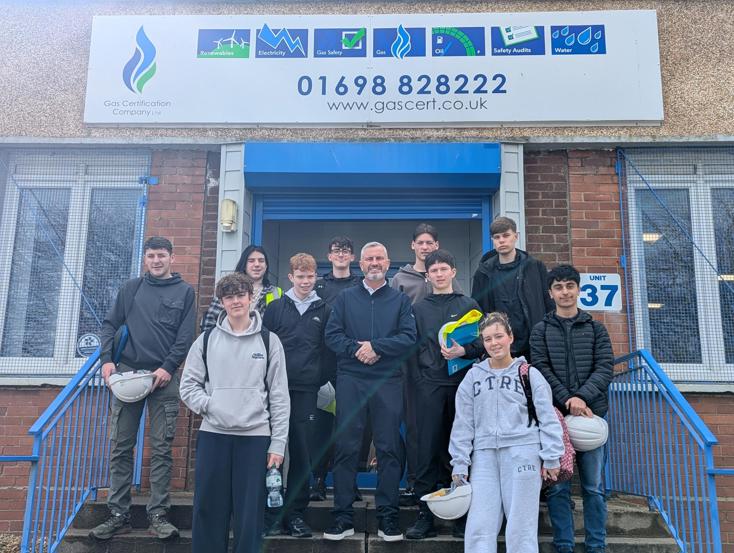
(Pictured: Andrew McNab, Managing Director of Gas Certification Company Ltd, with attendees of the Ignite Scholarship Scheme)
Founded in 1997 by George Loudon, Gas Certification Company Ltd was established to fill a gap in specialist gas training and assessment provision in the local area. Now operating from its larger Blantyre training centre, the business continues to support both experienced engineers and new entrants across domestic, commercial and specialist gas pathways, alongside renewable and low-carbon technologies.
Confidence beyond qualifications
While technical excellence remains at the heart of the centre, it's the way learners are treated as individuals that continues to shape Gas Cert’s approach today, with one clear focus on ensuring learners leave not only qualified, but genuinely confident and competent.
Joanne Kelly, Trainer Assessor and Centre Manager, says that commitment is central to the way the centre works. “It’s not just about gaining another qualification,” she explains. “It’s about making sure that when candidates leave the centre, they know they can confidently go out and physically do the job they’ve trained to do.”
A learner-first focus on confidence continues well beyond the point of qualification. Alongside training and assessment, the centre offers free refresher support within the first year of qualification for learners who may not regularly use a specific skill or competency, helping them revisit calculations, processes and procedures before they need to apply them in the workplace.
Recent learner feedback reflects this experience. Michal Badowski, who completed his gas engineer qualification with Gas Cert, described the training as “well organised, professional, and friendly from start to finish,” adding that trainers were “very knowledgeable, supportive, and explained everything clearly.”
Meeting learners where they are
For Gas Certification Company, inclusivity starts with being adaptable.
Rather than taking a one-size-fits-all approach, the team looks at each learner as an individual. Jo says, “We’re adaptable - that’s the main thing. We look at where someone is now, how they’re going to get to where they want to be, and whether there are commitments or circumstances we need to work around.”
In practice, this can mean accommodating religious observance, adapting teaching materials, allowing extra assessment time for learners with English as an additional language, or creating quieter environments for learners who need them.
Jo also described how the team supports learners who are stronger practically than theoretically, adjusting the way information is explained so that technical understanding is not lost in overly complex wording. For multilingual learners, this may mean rephrasing questions, explaining unfamiliar terms such as technical measurements, and ensuring learners are assessed on knowledge rather than language barriers.
As Jo says, “It’s usually not that they don’t know the answer, it’s just they don’t understand the question.”
It can also mean responding with flexibility when life outside the classroom becomes difficult. Examples include adjusting course dates for a learner whose wife was undergoing chemotherapy, allowing him to continue to progress through his training around her treatment schedule.
Inclusive support in action
Gas Cert’s inclusive culture is most visible in the practical ways it removes barriers for learners.
Jo shared one example of a learner with ADHD who found that even small noises or movement in the room could completely disrupt his concentration during assessments. Rather than expecting him to manage in the standard environment, the centre arranged a separate room and an additional invigilator so he could complete his assessment without unnecessary distractions.
“As soon as that hyperfocus is disrupted, it can be really difficult to get back into it,” says Jo. “So, if somebody needs a separate room, we make sure they have that.”
The same flexibility applies to learners with medical conditions, where alternative arrangements may be needed if sitting for long periods becomes difficult. Jo explained that the team’s focus is always on removing practical barriers so learners can perform at their best.
For the team, inclusivity is not about lowering expectations. It is about making sure every learner has a fair and accessible opportunity to demonstrate what they know.
More than representation
For Gas Certification Company, inclusivity is understood in the widest sense.
Jo explains: “I think a lot of people misunderstand the word inclusivity. They think of it in terms of male and female, they don’t realise it’s everything - confidence, learning needs, language barriers, mental health and medical conditions, everything. It’s about making sure everybody gets treated fairly and equally.”
That wider understanding of inclusion has helped shape the culture of the centre. From offering quiet spaces and flexible support to making sure the environment feels welcoming rather than intimidating, the focus is on helping people feel at ease, accepted and able to learn.
A welcoming space
“We want people to feel comfortable,” says Jo. “Creating a space where people can come in and feel they belong.”
That philosophy can be seen in the way the centre has intentionally created a welcoming environment from the moment learners arrive. As Jo puts it, “our doors are open to anybody that wants to come in and ask questions.” From a friendly reception area with comfortable seating to tea, coffee and biscuits always on offer, the aim is to reduce the stress that can come with reassessment and high-stakes qualifications.
A welcoming atmosphere is something learners notice too. Ross Kirkland described the team as “highly welcoming, knowledgeable and down to earth,’ adding that ‘the facilities are well equipped and provided a great environment for practical and theoretical learning and qualification on multiple traditional and renewable heating technologies.”
Jo highlights that this sense of comfort is especially important in gas ACS training, where even the most experienced engineers can arrive feeling very anxious and under-pressure when faced with the five-yearly re-assessment, “The person who walks through the door on a Monday morning is completely different from the person who leaves after their assessments,” says Jo. “By the end of the week, the weight has been lifted.”
This awareness of learner stress has also led the team to strengthen its internal understanding and recognition of mental health and wellbeing, through mental health awareness training. Jo is clear that, in many cases, “nerves, pressure and personal circumstances can all affect how a learner presents in the centre.”
Rather than viewing behaviour in isolation, the team takes time to understand the wider context behind it.
That culture extends behind the scenes too. As Jo notes, “there is no sense of “he jobs” and “she jobs” within the team. The focus is simply on who is best placed to get the job done.” A clear sentiment that reinforces the centre’s wider commitment to equality in practice.
Opening up the industry
The wider understanding of inclusivity also underpins how the centre engages with the next generation of engineers.
Gas Certification Company regularly attends school and college careers events, supporting local initiatives that help young people understand the opportunities and routes available in building services engineering. This outreach work is particularly important in helping challenge perceptions around who belongs in the industry.
Jo’s own presence at careers events has already helped young women feel more confident approaching the centre and asking questions about progression routes. The centre is also conscious of the importance of representation, particularly in showing young women that gas training and assessment is not just “a man’s world.”
“It definitely makes them feel more confident to come up and speak when they can see someone like them in the role,” she says.
Alongside this outreach, Gas Cert has also developed the Ignite Scholarship Scheme to help bridge the gap between school and skilled careers, responding directly to the lack of visible pathways many young people face when considering the sector.
This proactive work reflects the centre’s belief that inclusivity starts long before a learner books onto a course.
The centre’s people-first approach reaches into the wider community too. From fundraising to install an on-site defibrillator to supporting local sports clubs, schools and charities, Gas Certification Company demonstrates an inclusive mindset beyond training delivery.
Why the Inclusivity Charter matters
For Gas Certification Company, the LCL Awards Inclusivity Charter reflects the values that already underpin it’s day-to-day practice: fairness, flexibility, awareness and respect for individual needs.
For Jo specifically, one of the biggest benefits is the reassurance the Charter gives learners before training even begins. In an industry that can still feel intimidating to some, visible recognition of Gas Cert’s values help reduce barriers from the outset.
“We want people to know straight away that our doors are open,” she says. “We welcome everybody, from all walks of life.”
At Gas Certification Company, inclusivity is not treated as a separate initiative - it’s embedded into how the centre teaches, supports and develops every learner on their training journey.
(Pictured: Andrew McNab, Managing Director of Gas Certification Company Ltd, with attendees of the Ignite Scholarship Scheme)
Founded in 1997 by George Loudon, Gas Certification Company Ltd was established to fill a gap in specialist gas training and assessment provision in the local area. Now operating from its larger Blantyre training centre, the business continues to support both experienced engineers and new entrants across domestic, commercial and specialist gas pathways, alongside renewable and low-carbon technologies.
Confidence beyond qualifications
While technical excellence remains at the heart of the centre, it's the way learners are treated as individuals that continues to shape Gas Cert’s approach today, with one clear focus on ensuring learners leave not only qualified, but genuinely confident and competent.
Joanne Kelly, Trainer Assessor and Centre Manager, says that commitment is central to the way the centre works. “It’s not just about gaining another qualification,” she explains. “It’s about making sure that when candidates leave the centre, they know they can confidently go out and physically do the job they’ve trained to do.”
A learner-first focus on confidence continues well beyond the point of qualification. Alongside training and assessment, the centre offers free refresher support within the first year of qualification for learners who may not regularly use a specific skill or competency, helping them revisit calculations, processes and procedures before they need to apply them in the workplace.
Recent learner feedback reflects this experience. Michal Badowski, who completed his gas engineer qualification with Gas Cert, described the training as “well organised, professional, and friendly from start to finish,” adding that trainers were “very knowledgeable, supportive, and explained everything clearly.”
Meeting learners where they are
For Gas Certification Company, inclusivity starts with being adaptable.
Rather than taking a one-size-fits-all approach, the team looks at each learner as an individual. Jo says, “We’re adaptable - that’s the main thing. We look at where someone is now, how they’re going to get to where they want to be, and whether there are commitments or circumstances we need to work around.”
In practice, this can mean accommodating religious observance, adapting teaching materials, allowing extra assessment time for learners with English as an additional language, or creating quieter environments for learners who need them.
Jo also described how the team supports learners who are stronger practically than theoretically, adjusting the way information is explained so that technical understanding is not lost in overly complex wording. For multilingual learners, this may mean rephrasing questions, explaining unfamiliar terms such as technical measurements, and ensuring learners are assessed on knowledge rather than language barriers.
As Jo says, “It’s usually not that they don’t know the answer, it’s just they don’t understand the question.”
It can also mean responding with flexibility when life outside the classroom becomes difficult. Examples include adjusting course dates for a learner whose wife was undergoing chemotherapy, allowing him to continue to progress through his training around her treatment schedule.
Inclusive support in action
Gas Cert’s inclusive culture is most visible in the practical ways it removes barriers for learners.
Jo shared one example of a learner with ADHD who found that even small noises or movement in the room could completely disrupt his concentration during assessments. Rather than expecting him to manage in the standard environment, the centre arranged a separate room and an additional invigilator so he could complete his assessment without unnecessary distractions.
“As soon as that hyperfocus is disrupted, it can be really difficult to get back into it,” says Jo. “So, if somebody needs a separate room, we make sure they have that.”
The same flexibility applies to learners with medical conditions, where alternative arrangements may be needed if sitting for long periods becomes difficult. Jo explained that the team’s focus is always on removing practical barriers so learners can perform at their best.
For the team, inclusivity is not about lowering expectations. It is about making sure every learner has a fair and accessible opportunity to demonstrate what they know.
More than representation
For Gas Certification Company, inclusivity is understood in the widest sense.
Jo explains: “I think a lot of people misunderstand the word inclusivity. They think of it in terms of male and female, they don’t realise it’s everything - confidence, learning needs, language barriers, mental health and medical conditions, everything. It’s about making sure everybody gets treated fairly and equally.”
That wider understanding of inclusion has helped shape the culture of the centre. From offering quiet spaces and flexible support to making sure the environment feels welcoming rather than intimidating, the focus is on helping people feel at ease, accepted and able to learn.
A welcoming space
“We want people to feel comfortable,” says Jo. “Creating a space where people can come in and feel they belong.”
That philosophy can be seen in the way the centre has intentionally created a welcoming environment from the moment learners arrive. As Jo puts it, “our doors are open to anybody that wants to come in and ask questions.” From a friendly reception area with comfortable seating to tea, coffee and biscuits always on offer, the aim is to reduce the stress that can come with reassessment and high-stakes qualifications.
A welcoming atmosphere is something learners notice too. Ross Kirkland described the team as “highly welcoming, knowledgeable and down to earth,’ adding that ‘the facilities are well equipped and provided a great environment for practical and theoretical learning and qualification on multiple traditional and renewable heating technologies.”
Jo highlights that this sense of comfort is especially important in gas ACS training, where even the most experienced engineers can arrive feeling very anxious and under-pressure when faced with the five-yearly re-assessment, “The person who walks through the door on a Monday morning is completely different from the person who leaves after their assessments,” says Jo. “By the end of the week, the weight has been lifted.”
This awareness of learner stress has also led the team to strengthen its internal understanding and recognition of mental health and wellbeing, through mental health awareness training. Jo is clear that, in many cases, “nerves, pressure and personal circumstances can all affect how a learner presents in the centre.”
Rather than viewing behaviour in isolation, the team takes time to understand the wider context behind it.
That culture extends behind the scenes too. As Jo notes, “there is no sense of “he jobs” and “she jobs” within the team. The focus is simply on who is best placed to get the job done.” A clear sentiment that reinforces the centre’s wider commitment to equality in practice.
Opening up the industry
The wider understanding of inclusivity also underpins how the centre engages with the next generation of engineers.
Gas Certification Company regularly attends school and college careers events, supporting local initiatives that help young people understand the opportunities and routes available in building services engineering. This outreach work is particularly important in helping challenge perceptions around who belongs in the industry.
Jo’s own presence at careers events has already helped young women feel more confident approaching the centre and asking questions about progression routes. The centre is also conscious of the importance of representation, particularly in showing young women that gas training and assessment is not just “a man’s world.”
“It definitely makes them feel more confident to come up and speak when they can see someone like them in the role,” she says.
Alongside this outreach, Gas Cert has also developed the Ignite Scholarship Scheme to help bridge the gap between school and skilled careers, responding directly to the lack of visible pathways many young people face when considering the sector.
This proactive work reflects the centre’s belief that inclusivity starts long before a learner books onto a course.
The centre’s people-first approach reaches into the wider community too. From fundraising to install an on-site defibrillator to supporting local sports clubs, schools and charities, Gas Certification Company demonstrates an inclusive mindset beyond training delivery.
Why the Inclusivity Charter matters
For Gas Certification Company, the LCL Awards Inclusivity Charter reflects the values that already underpin it’s day-to-day practice: fairness, flexibility, awareness and respect for individual needs.
For Jo specifically, one of the biggest benefits is the reassurance the Charter gives learners before training even begins. In an industry that can still feel intimidating to some, visible recognition of Gas Cert’s values help reduce barriers from the outset.
“We want people to know straight away that our doors are open,” she says. “We welcome everybody, from all walks of life.”
At Gas Certification Company, inclusivity is not treated as a separate initiative - it’s embedded into how the centre teaches, supports and develops every learner on their training journey.